What are the four types of fiber optic connectors?
Jul 09, 2025
1. SC Connector (Subscriber Connector)
Design & Construction:
Ferrule Diameter: 2.5 mm ceramic ferrule, precisely aligned to hold the fiber core.
Connector Body: Square plastic housing for easy push-pull mating.
Locking: Snap-in push-pull, providing tactile click and secure fit.
Polishing: Usually UPC (Ultra Physical Contact) or APC (Angled Physical Contact) polishing.
Performance:
Insertion Loss: Typically 0.2–0.5 dB.
Return Loss:
UPC: ~50 dB
APC: >60 dB (lower back reflection, better for analog systems)
Durability: Rated for up to 500 mating cycles.
Ferrule alignment and polishing critical for minimizing loss/reflection.
Use Cases:
Widely used in FTTH (fiber to the home) deployments.
Cable TV networks.
Telecom central offices.
Data centers for moderate-density fiber management.
Supports both single-mode and multimode fibers.
Handling Tips:
Avoid touching the ferrule tip to prevent contamination.
Use dust caps when not connected.
Clean with specialized fiber wipes or alcohol.
2. LC Connector (Lucent Connector)
Design & Construction:
Ferrule Diameter: 1.25 mm ceramic ferrule (half the size of SC).
Connector Body: Small form factor with a latch mechanism similar to RJ45.
Polishing: Mostly UPC or APC polishing for single-mode fibers.
High precision ferrule guides fiber with sub-micron alignment.
Performance:
Insertion Loss: Typically 0.1–0.3 dB, lower due to better alignment and smaller ferrule.
Return Loss: Similar to SC; APC versions provide better reflection control.
High-density capability allows up to twice the fiber ports per rack unit compared to SC.
Durability: ~500 mating cycles.
Use Cases:
Data centers with high port density requirements.
10G, 40G, 100G Ethernet deployments.
SAN (Storage Area Network) and enterprise networks.
High-performance telecom and metro networks.
Handling Tips:
Delicate due to smaller size; avoid excessive force.
Use fiber inspection scopes regularly in critical networks.
Dust caps essential due to smaller ferrule size.
3. ST Connector (Straight Tip)
Design & Construction:
Ferrule Diameter: 2.5 mm ceramic ferrule.
Connector Body: Cylindrical metal housing with bayonet twist-lock coupling.
Polishing: Mostly PC or UPC polishing.
The bayonet coupling ensures a reliable mechanical connection in harsh conditions.
Performance:
Insertion Loss: 0.2–0.5 dB.
Return Loss: Generally lower performance than APC connectors.
Mechanical robustness makes it suited for industrial environments.
Durability: Can withstand rough handling and vibration.
Use Cases:
Older multimode LANs and campus networks.
Industrial and manufacturing environments.
Military and aerospace applications where mechanical locking is critical.
Less common in new installations, but still used in legacy systems.
Handling Tips:
Requires twisting motion to connect/disconnect.
Suitable for environments where vibration might loosen push-pull connectors.
Cleaning and inspection required as with all fiber connectors.
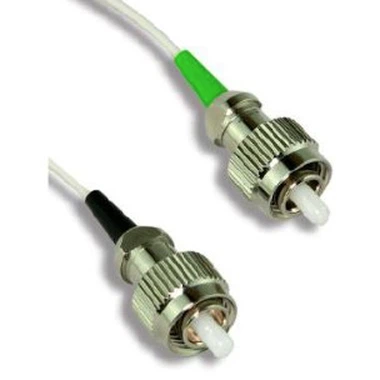
4. FC Connector (Ferrule Connector)
Design & Construction:
Ferrule Diameter: 2.5 mm zirconia ceramic ferrule.
Connector Body: Threaded metal shell for screw-on secure coupling.
Polishing: Often APC polishing for single-mode fibers to minimize back reflection.
Designed for precise fiber end-face contact with high stability.
Performance:
Insertion Loss: Typically 0.15–0.3 dB.
Return Loss: Superior for APC polished connectors (>60 dB).
Excellent vibration resistance due to threaded coupling.
Durability: High, but slower to connect/disconnect.
Use Cases:
Test and measurement equipment requiring stable connections.
Single-mode telecom and CATV networks.
Harsh environments with vibration or temperature variation.
Laboratory and instrumentation.
Handling Tips:
Use proper torque to avoid fiber damage.
Avoid frequent connect/disconnect cycles to preserve ferrule integrity.
Keep connector clean and capped when unused.
Additional Technical Details
Polishing Types:
PC (Physical Contact): Fiber end faces are polished flat or slightly curved to touch physically; moderate back reflection.
UPC (Ultra Physical Contact): Higher precision polishing, reduced back reflection (~50 dB).
APC (Angled Physical Contact): Fiber end faces polished at an 8° angle to minimize back reflection (< -65 dB); critical for analog and high-speed systems.
Ferrule Material:
Usually zirconia ceramic due to excellent durability and thermal stability.
Plastic ferrules exist but offer lower performance, mostly for cost-sensitive multimode applications.
Insertion & Return Loss:
Key metrics for fiber connectors. Low insertion loss ensures minimal signal degradation.
Low return loss (high reflection loss) prevents signal reflection that can interfere with transmission.
Mating Cycles:
Connector longevity measured in mating cycles (typically 500–1000).
Over time, polishing and ferrule wear can increase losses.